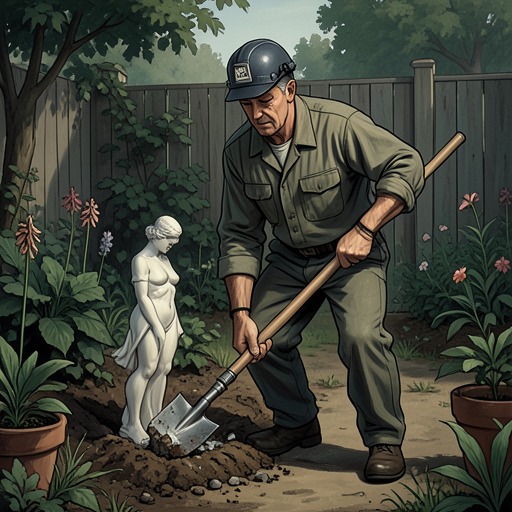
Orestes Buries the Aphrodite Statue
Cartes Postales from GreeceOrestes Buries the Aphrodite Statue is an act of concealment shaped by grief and practical fear: after Costas Arvanitis dies beside the sculpture, Orestes hides it again rather than invite archaeological intervention into the village. He keeps a fragment for his friend, turning the burial of the statue into a quiet final gesture of loyalty.
The Discovery and Orestes’s Decision
When Orestes reaches Costas’s field, his friend is already dead. Costas’s body bears a smile; as Orestes moves him aside, he feels a hard piece of stone in Costas’s top pocket. He removes it, then wraps the body in the blanket that had protected the Aphrodite statue. The juxtaposition is intimate and stark: the statue’s covering becomes a shroud, while a fragment of the sculpture remains with the dead man.
Orestes understands the discovery not as an uncomplicated treasure but as a threat to village life. Ancient remains can bring building works to a halt; the Thessaloniki metro is given as an example of work taking ten times longer when archaeology is suspected nearby. He expects that villagers would not welcome the discovery, since archaeologists might search their land and restrict development or agriculture. His choice to conceal the statue is therefore presented as a deliberate response to likely disruption, not as a failure to recognize its value.
Reburying the Statue
Orestes covers the sculpture with layer upon layer of soil. The work takes about an hour: he replaces the earth, builds it up perhaps a little higher than before, and smooths the surface. The measured labor makes the concealment tangible. He does not simply leave the statue exposed or abandon it; he restores the field’s ordinary appearance, returning the discovery to the ground where it can remain unseen.
The act also leaves the statue’s future unresolved. The possibility remains that someone digging there years later may make a similar discovery, and Costas may not have been the first person to find it. Orestes’s intervention postpones discovery rather than guaranteeing permanent secrecy.
The Fragment and the Funeral
After covering the statue, Orestes drives back to the village and goes to see Stella. She supposes that Costas died of a heart attack, and the doctor agrees. Orestes then visits the kafenion; with two other village men, he loads a wheelbarrow onto a truck and goes to collect the body. The funeral is to take place the following day.
Before the burial, Orestes plans to visit Costas at home, where his friend will lie in an open casket, and discreetly slip the precious Aphrodite fragment into the breast pocket of Costas’s only suit. He knows Costas would want it there. Thus the statue is hidden from the village, but a piece of it is returned to the person whose attachment brought him beside it. The episode’s final emphasis is not on public possession or archaeological recognition, but on Orestes’s care for his dead friend and the small, private continuity he preserves between Costas and the sculpture.